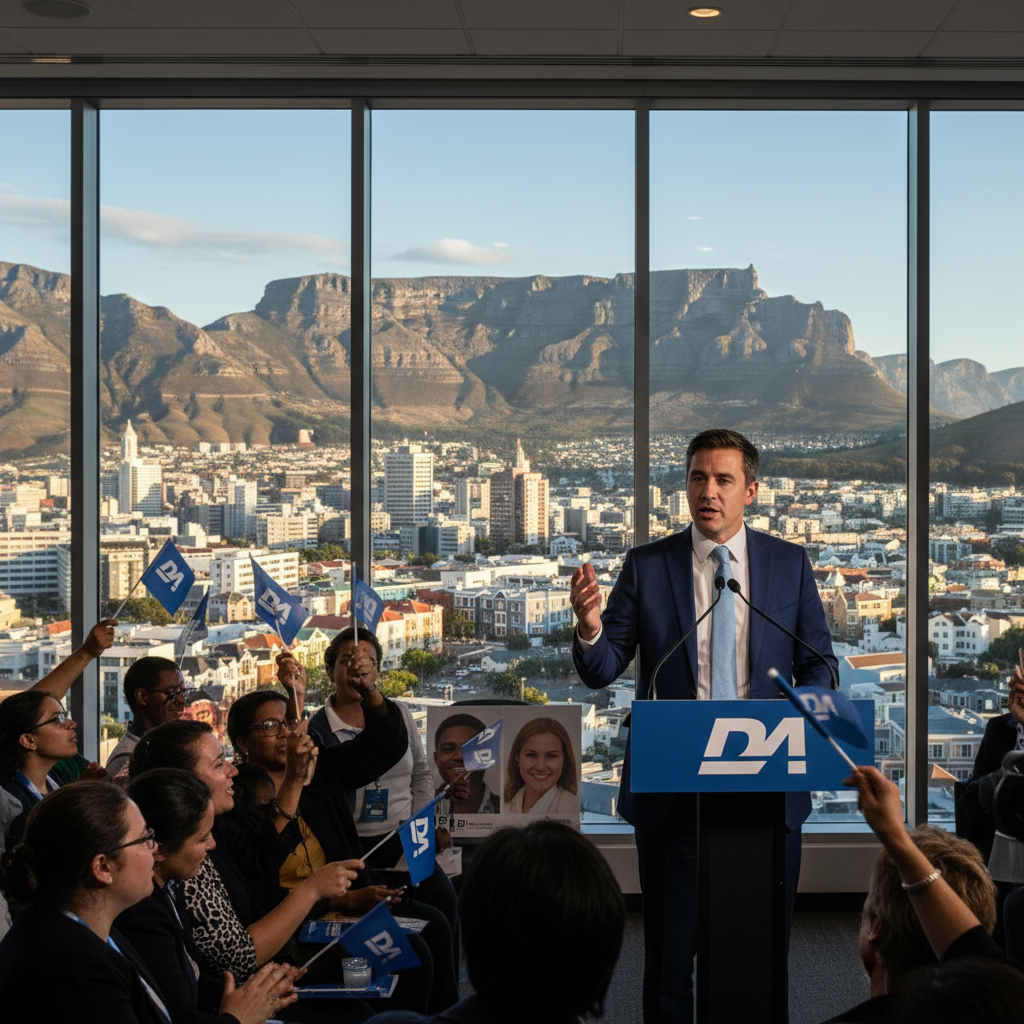
In a pivotal moment for South African politics, Geordin Hill-Lewis, the youthful mayor of Cape Town, has been elected as the new leader of the Democratic Alliance (DA). This decision, made on April 12, 2026, marks a significant turning point for the DA as it seeks to strengthen its position against the ruling African National Congress (ANC). At 39 years old, Hill-Lewis brings a fresh perspective and a clear agenda aimed at revitalizing the party’s approach as it prepares for the upcoming national elections set for 2029.
Hill-Lewis, who has been at the helm of Cape Town since 2021, previously served as the party's federal chairperson and as a shadow minister for finance. Since assuming the mayoralty, he has focused on key issues including housing, public safety, and economic recovery, all of which he believes are critical in challenging the ANC's long-standing dominance in South African politics. His election as DA leader intends to harness these priorities while expanding the party's national influence.
"We have a great opportunity to address the needs of South Africans and present viable alternatives to the ANC's policies," Hill-Lewis stated shortly after his election, according to sources close to the party. His vision includes not only winning over traditional DA supporters but also reaching out to disillusioned ANC voters who may be yearning for change.
“Hill-Lewis's leadership promises a formidable challenge to the ANC's reign, harnessing Cape Town's spirit for national change.”
The DA's evolution has been marked by its entry into a coalition government in 2024, a move that followed the ANC’s loss of its overall majority. Analysing this shift, many political observers speculate that Hill-Lewis's leadership may serve as a catalyst for a broader coalition that can take on the ANC's parliamentary majority more effectively.
The city of Cape Town, under Hill-Lewis’s guidance, has been highlighted as a successful example of effective governance in South Africa. His administration's proactive approach to urban management and economic restoration post-COVID-19 has garnered both praise and criticism. Supporters believe that his policies can serve as a template for a national agenda that better resonates with middle-class and undecided voters throughout the country.
The question of racial and economic equity remains at the forefront as Hill-Lewis embarks on his new role. Critics argue that while the DA has been successful in urban municipalities, it faces challenges in appealing to voters in economically disadvantaged areas. According to various sources, Hill-Lewis acknowledges these challenges, advocating for policies that bolster economic opportunities across all demographics, stating, "We must ensure that our solutions benefit everyone, not just a select few."
As Hill-Lewis prepares to navigate his party through uncharted territories leading up to the 2029 elections, the stakes are high. With South Africa's political and economic landscape continually shifting, his leadership will be scrutinised not only by political opponents but also by constituents who demand accountability and results.
The DA's overall strategy may revolve around Hill-Lewis's youthfulness and energy, potentially appealing to younger voters who feel neglected by the traditional political landscape. Furthermore, as Cape Town continues to grapple with issues around climate change and sustainable urban development, Hill-Lewis's plans for eco-friendliness in policymaking could resonate well with environmentally conscious citizens.
Why This Matters Hill-Lewis's election as the DA's new leader is significant not only for the party but also for Cape Town and South Africa as a whole. His vision promises to reshape the political landscape, offering a challenge to the ANC's longstanding hold on power. By redirecting the party’s focus toward pressing local issues such as housing and public safety, Hill-Lewis aims to unify the party's base while attracting new supporters concerned with socio-economic inequities. This transition underscores the importance of strategic leadership in the DA's pursuit of becoming a credible alternative to the ANC while ensuring that Cape Town remains a focal point in national politics.
As the 2029 national elections loom closer, Hill-Lewis and the DA’s success could hinge on their ability to adapt their message to reflect the needs and aspirations of all South Africans. If Hill-Lewis navigates these upcoming challenges successfully, he may well redefine the future political landscape, not just for the DA, but for the entire nation.